Person reading and reflecting

Stacks Image 50

Understanding RIPP. Why We Keep Reacting in Ways We Later Regret

Most people don't wake up intending to become angry. They don't decide to become anxious, argue with the people they love, or spend the day feeling overwhelmed, resentful or unhappy. Yet these reactions happen every day, often so quickly that it feels as though we had no choice.

Why?

That question has shaped more than twenty years of working with people experiencing anger, anxiety, relationship conflict, stress, shame, addiction and depression; I kept noticing the same emotional process occurring beneath the surface, regardless of the problem they presented with. That observation became RIPP.

What Is RIPP?

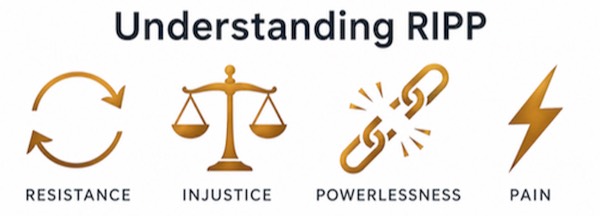
RIPP stands for:

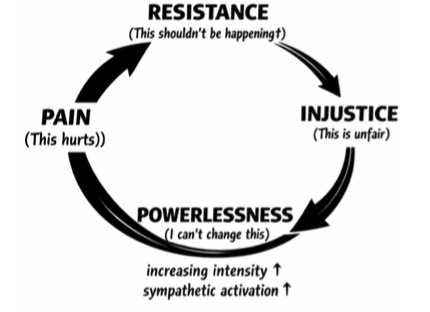
Resistance – This shouldn't be happening.
Injustice – It's unfair.
Powerlessness – I can't change this.
Pain – The emotional suffering that follows.

These four experiences often occur so quickly that we don't realise they are happening. Instead, we simply experience the emotion that follows—anger, anxiety, resentment, sadness, fear or withdrawal. The emotion feels like the problem. In reality, it is often the consequence of a deeper emotional process that has already begun.

The RIPP Loop

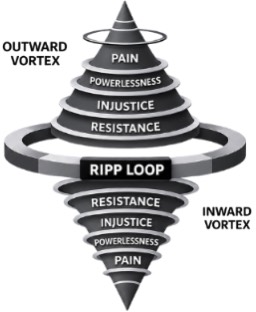
Once Resistance, Injustice, Powerlessness and Pain begin feeding one another, they create what I call the RIPP Loop. Pain increases resistance, resistance strengthens the sense of injustice, and feeling powerless intensifies the pain. Around and around the cycle goes.
The longer the loop continues, the more convincing it becomes. Our thoughts begin supporting it, our body begins reinforcing it, and before long the emotional reaction feels completely justified. Most people don't realise they're inside a loop. They simply believe they're reacting to life.

The RIPP Vortex

Sometimes the loop becomes so intense that it begins drawing us further and further into emotional suffering. This is what I describe as the RIPP Vortex. When caught in the vortex, our thinking narrows, perspective disappears, the nervous system prepares for threat, familiar thoughts repeat, emotions intensify, and behaviours become increasingly automatic. Whether the reaction moves outward through anger, blame and conflict, or inward through anxiety, shame and unhappiness, the underlying process is remarkably similar. The vortex doesn't create who we are. It temporarily takes us away from who we are.

Stacks Image 38
Stacks Image 40
Why Understanding RIPP Matters

Most approaches focus on managing symptoms. RIPP helps explain why those symptoms keep returning.

When you begin recognising the loop as it develops, something important happens. You stop believing that every thought, feeling and impulse must be acted upon. Instead, you begin noticing the process rather than becoming consumed by it.

That awareness creates choice, and choice creates freedom.

The goal is not to suppress emotions. It is to recognise the moment emotional conditioning begins to take over so you can respond with greater clarity rather than automatic reaction.

Is RIPP a Therapy?

No. RIPP is a practical, psychologically grounded approach to understanding and changing conditioned emotional responses. Rather than diagnosing or labelling you, RIPP helps you recognise the conditioned processes behind reactions such as anger, anxiety, unhappiness and relationship conflict. These responses can become so automatic that they feel like part of who you are, when in fact they are learned patterns of responding. By understanding what is happening and becoming aware of the response as it occurs, you can begin to interrupt the old conditioning and develop a more conscious way of responding. RIPP can be used on its own or alongside counselling, psychotherapy, coaching and other approaches. The aim is not to fix you as a person. It is to help you change the conditioned responses that may be causing unnecessary emotional suffering in your life.


Who Can Benefit?

People often discover RIPP because they are struggling with:

Anger that feels impossible to control
Anxiety that keeps returning
Relationship conflict
Aggression
Destructive behaviour
Stress and emotional overwhelm
Resentment or bitterness
Shame or self-criticism
Feeling stuck in the same emotional patterns

Although these experiences appear very different, they often involve the same underlying emotional process. Understanding that process can be the beginning of lasting change.

The End of RIPP

The end of RIPP is not the end of emotion. It is not becoming passive or pretending that life is always easy. It is the end of unnecessary emotional suffering created by getting trapped in automatic patterns of resistance. Life will always bring challenges. There will still be disappointment, grief, injustice and loss. But when we stop becoming trapped inside the RIPP Loop, we discover something remarkable. We are no longer driven by our emotional reactions. Instead, we respond with greater awareness, wisdom, and freedom.

Learn More

If these ideas resonate with you, you can explore them in greater depth in my book, The End of RIPP, and discover how they apply to your own life by working with me one-to-one online.

Sometimes a single insight changes everything. Sometimes that insight is simply recognising the loop you've been living in.

Book Your Initial Session

You don't need a preliminary consultation or a lengthy conversation about whether you should begin.
Your initial session is a full one-hour working session at £150.
We'll begin with what's happening in your life, what you would like to change and what appears to be driving the pattern. We won't spend the hour discussing what we might do at some point in the future.
We'll get down to work from the beginning.
After that session, you decide whether you would like another one. There is no obligation to continue and no predetermined number of sessions you have to complete.
I look forward to meeting you.
Stacks Image 52
© 2026 Gary Redmond